Proven Facts


Home   Harmful Effects (overall)
overall effects ages 13-19

Young Brains & its activity
Long term drinking


Harmful Effects


Ages 16-19

In our culture, we expect a gradual development of independence and self-identity by the age of nineteen. The physical manifestations of approaching adulthood require numerous psychological adjustments, in particular the development of how one views self in relation to others. The vast majority of adolescents attain their adult size and physical characteristics by the age of eighteen and the earlier differences between early and late bloomers are no longer evident. The process of abstract thinking changes along with physical development, becoming more complex and refined. Late adolescents are less bound by concrete thinking. A sense of time emerges where the individual can recognize the difference between past, present and future. They can adopt a future orientation that leads to the capacity to delay gratification. The individual develops a sense of equality with adults.

Self-certainty and an internal structure develop while teens experiment with different roles. By age nineteen, most adolescents are considering occupational choices and have begun to develop intimate relationships.


Ages 13 to 16

The age of 13 to 16 brings an enormous change in physical and psychological development. Throughout adolescence, girls remain about two years ahead of boys in their level of maturity. Some adolescents bloom early, and some bloom late, each having a different psychological challenge. Early bloomers may be expected to perform with individuals of their size, where late bloomers suffer from the problems of self-esteem that result from looking more immature than their peers.

Adolescents of this age group experience a great deal of ambivalence and conflict and they often blame outside world for their discomfort. As they struggle to develop their own identity, dependence upon parents gives way to a new dependence upon peers. The adolescent struggles to avoid dependence and may disparage parents devaluing past attachments. These early teens often find a new ego ideal that leads to idealization of sports figures or entertainers. Adolescents at this state are particularly vulnerable to people they would love to emulate.

The development of a self-concept is crucial at this stage. The adolescent must explore his own morals and values, questioning the accepted way of society and family in order to gain a sense of self. They make up their own mind about who they are and what they believe in. They must reassess the facts that were accepted during childhood, and accept, reject, or modify these societal norms as their own. The here and now thinking of earlier childhood gives way to a new capacity for abstract thought. These adolescents may spend long periods abstractly contemplating the "meaning of life" and "who am I."


Young Brains on Alcohol

Clearly, experimentation with alcohol during youth is bad news. But now research shows it's even worse than you think. Recent studies suggest that drinking harms the developing brains of adolescents and teens possibly even more than it does adults. The repercussions may include learning and memory problems, among others. If confirmed, the results provide additional evidence that young people should avoid alcohol.

Acting like a fool, vomiting and a day-after headache are a few common side effects. More seriously, it may lead to an arrest or, in excess amounts, spur an accidental injury, even death.

  Yet many young people consume alcohol. Approximately 9.7 million Americans aged 12 to 20 reported drinking alcohol in the month prior to a recent survey by the Substance Abuse and Mental Health Services Administration.

 Converging lines of research, however, now provide additional evidence that the young should steer clear of beer, wine and other alcoholic beverages. Although the work is still in an early stage, it appears that drinking can launch a damaging brain assault in teens and adolescents that may even surpass its effects in adults. The new research is leading to:

  • Insights into the sensitive brain development patterns of youth.

  • A clearer understanding of the biological and mental effects of alcohol.

  • Increased interest in alcohol prevention programs.

  Findings on brain development provided some of the first clues that young brains may be more vulnerable to alcohol than adults.


   Researchers thought that the brain's key development finished within the first few years of life. Then recently they discovered that important brain regions continue to undergo refinement at least into a person's early twenties. For example, one study compared the brain structure of kids aged 12 to 16 with young adults aged 23 to 30. Several brain areas showed signs that their circuits pare down and fine tune between adolescence and young adulthood. Included is the frontal cortex, which helps process highly complex information. Another study examined molecular changes in the memory brain area, known as the hippocampus, and found that it is still maturing in rats equivalent in age to human teenagers.

  The findings imply that introducing alcohol during this developmental stage can potentially harm the growing system and associated brain functions, such as learning and memory. Several, more specific studies, back this idea.

  In one report, the equivalent of about five drinks in people impairs the ability of adolescent rats, but not adults, to learn a memory task. Other research examined two molecular processes tied to memory, termed long-term protestation and N-methyl-D-aspirate receptor activity. Adolescent rats that received the equivalent of about one to two drinks experience more interference with these processes than do adults.

  Perhaps most troublesome is work suggesting long-lasting alterations. One study found that the equivalent of about 10 drinks produces more extensive brain damage in adolescent rats than in adults.

  Findings are hard to confirm in humans because scientists can't provide underage children with alcohol and then dissect their brains. Some evidence, however, is in line with the animal work.

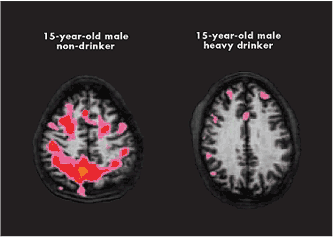
  For example, a study of young people indicates that those who start drinking during adolescence have smaller hippocampus memory areas than non-drinkers. Another study finds that following the consumption of about two to three drinks, people in their early twenties perform worse on memory tests than people in their late twenties. More recently researchers examined subjects aged 18 to 25 who reported a history of drinking about a six-pack on weekend nights. Compared with non-drinkers, they perform somewhat worse on memory tasks. Furthermore, their performance correlates with poor brain activity. Preliminary findings show similar results with younger teens who drink heavily (see images). Their brain response is also diminished, although they manage to perform okay on the tasks. The researchers plan to investigate further how various drinking histories affect different age groups.

  Some scientists also believe that the immature young brain may put kids at a disadvantage when they encounter situations involving alcohol. Possibly, their brains can't provide the foresight that they should avoid drinking because it's dangerous. Also, once experimentation begins, brain areas that make a person feel good and want to drink again may be in an underdeveloped state and more easily influenced.

  Overall, the research adds fire to an often-repeated message: Just say no.


Long Term Effects